A body that sits at a screen all day fails in predictable places. The neck drifts forward towards the screen, the upper back rounds to follow it, the hips stiffen from hours in the same angle, and the breath gets shallow and stays that way through an afternoon of messages. Most people do not notice any of it until the evening, when it arrives all at once as a headache or a sore back.
The school sees this every week, at its workshops for offices as much as in the studio. The good news is that the fixes are small. Here are five of them, in the order you might do them in the middle of a working day. None needs a mat or a change of clothes.
Roll the shoulders back
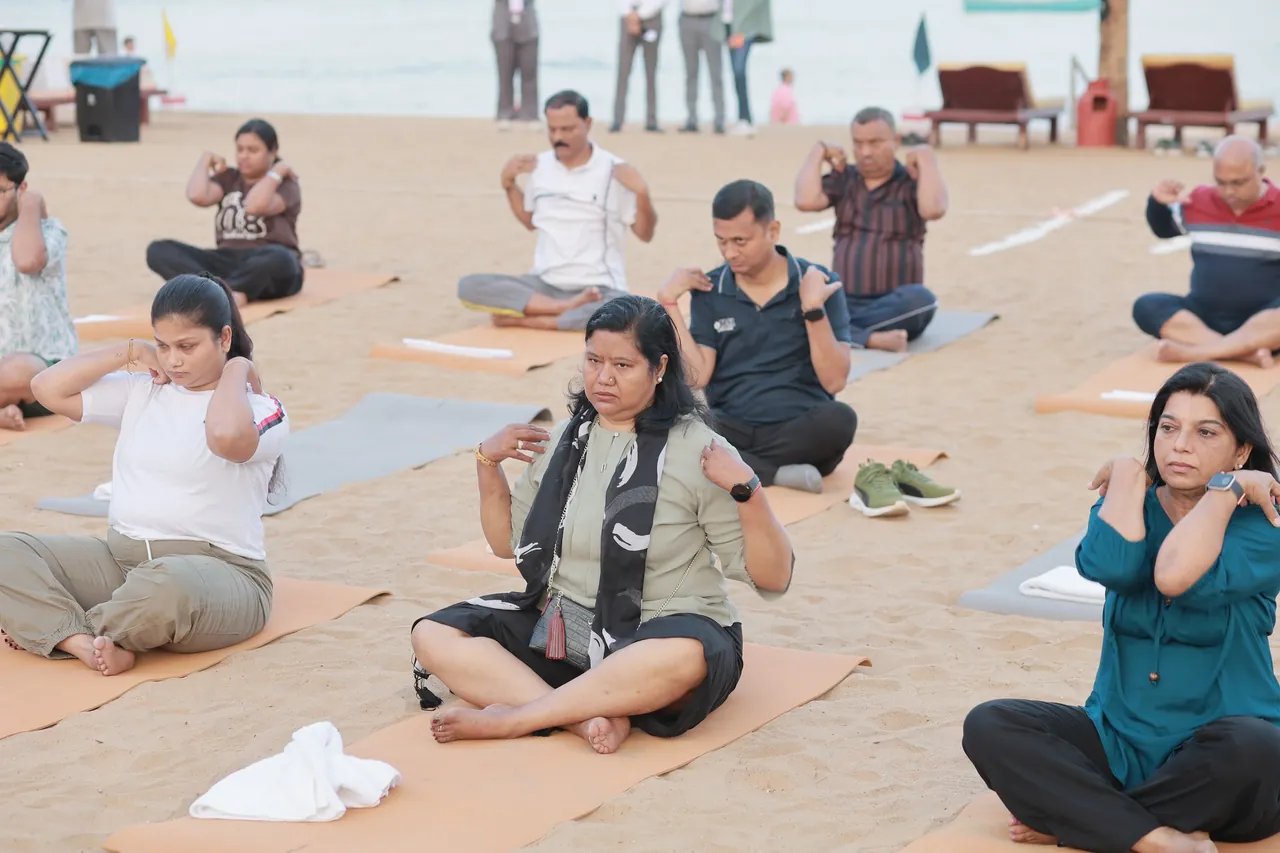
Sit near the front of your chair with both feet flat on the floor. Place your fingertips on your shoulders, elbows pointing forward. Breathing in, lift the elbows and draw them up and back in a large slow circle; breathing out, let them sweep down and round to the front again. Make the circles as big as the shoulders will allow without the neck tightening.
Do five slowly in one direction and five in the other. The point is not the movement itself but what it reverses: hours of the shoulders rolling forward and up towards the ears. Many people find their shoulders sitting noticeably lower afterwards, and only then realise where they had been holding them.
Turn, sitting down
Still sitting near the front of the chair, breathe in and lengthen up through the crown of the head. Breathing out, turn your chest to the right, placing your left hand on the outside of your right knee and your right hand behind you on the seat. Keep both sitting bones heavy on the chair. Hold for five slow breaths, lengthening a little on each in breath and turning a little on each out breath, then come back to the centre and turn to the left.
The twist should come from the ribs, not from the neck and not from yanking on the knee. This is the same principle the school teaches in the full seated twist, and the guide to Ardha Matsyendrasana explains why length has to come before turning.
Fold forward and let the head hang
Stand up, feet hip width apart, knees softly bent. Breathing out, fold forward from the hips and let your upper body hang, arms heavy, the head completely loose. Bend the knees as much as you need to; this is not a hamstring stretch. Stay for five breaths, letting the weight of the head lengthen the back of the neck.
Come up slowly, rolling up one section of the spine at a time with the head coming up last. If standing is not practical, sit near the front of the chair, feet wide, and fold forward over your thighs instead. If you have high blood pressure or tend to feel dizzy, keep the head above the heart and do the seated version gently.
Breathe out for longer than you breathe in
This is the one you can do in the middle of a meeting. Breathe in through the nose for a count of four, and out through the nose for a count of six or eight. Nobody will notice, and after a few minutes you will. Slowing the out breath is one of the simplest ways there is to steady yourself.
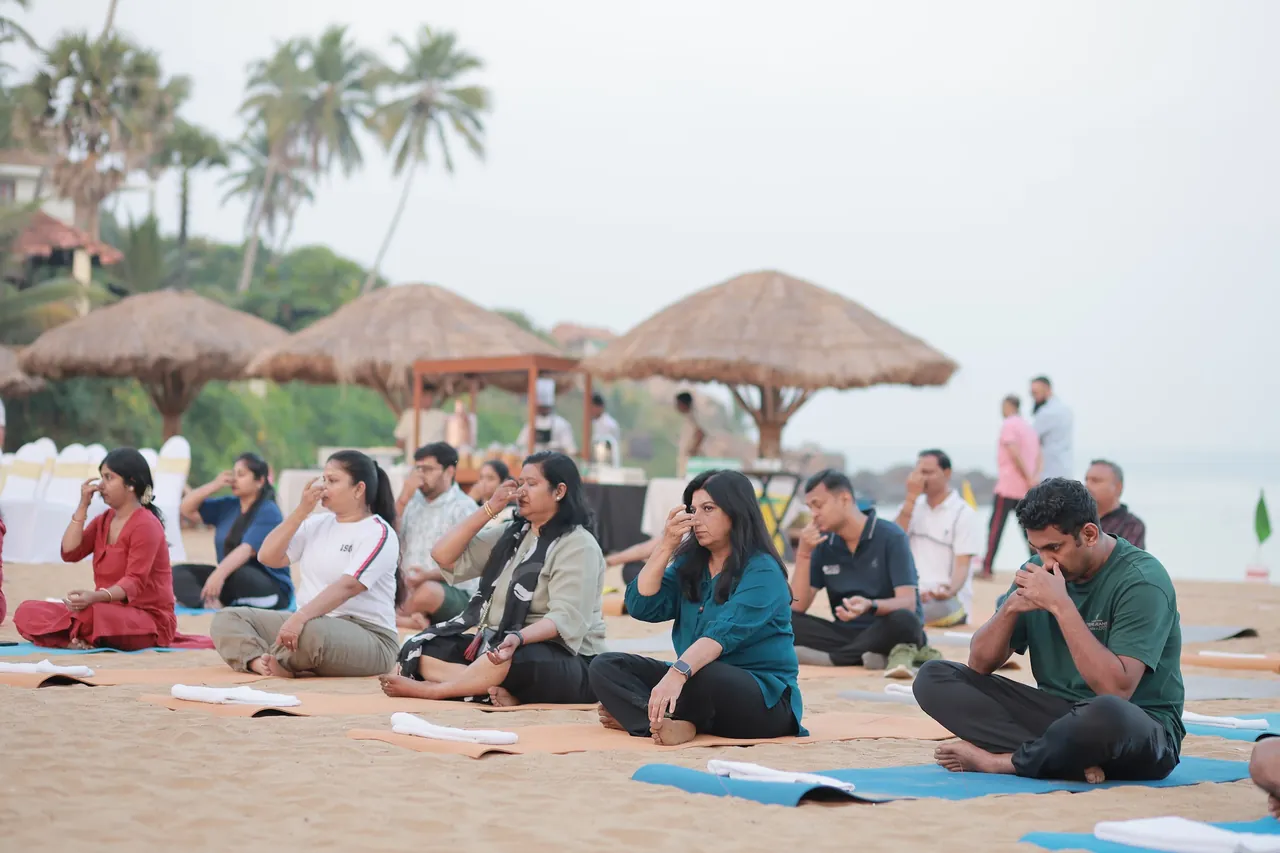
When you have a little more privacy, five minutes of alternate nostril breathing goes further. It is the breathing practice students most often keep up at home, and it needs nothing but a chair.
Two minutes of doing nothing
At some point in the afternoon, sit back in your chair, rest your hands on your thighs, close your eyes and simply feel the breath going in and out for two minutes. Do not try to change it. Do not plan the rest of the day. When the mind wanders off, notice where it went and come back.
After lunch, two minutes of vajrasana, kneeling and sitting back on the heels, does the same job and is the one posture traditionally taken on a full stomach.
When it is more than stress
Tight shoulders and a stiff back from sitting are ordinary. Pain that spreads down an arm or a leg, numbness, tingling, or headaches that keep coming back are not, and they are a reason to see a doctor before you do anything else. Yoga is not a treatment and the school does not offer it as one.
If you have a specific problem you want to work on, the custom class builds a routine around your own history, inside whatever a doctor has told you.
For a whole team
If the office around you looks the way you feel, the school's corporate workshops run for two months, at basic level, for groups of up to 25, on site or live online. Breath work carries more of the load there than in any other course the school runs, because it is the part that transfers. Nobody is going to hold a shoulderstand before a meeting, but everybody can change how they are breathing during one.
Find the school
Avadhuta School of Yoga is at Vilasini Bhavan, on Kovalam Beach Road in Thiruvananthapuram, at the heart of Kovalam beach. Classes run Monday to Saturday between 5.30 am and 7.30 pm, and the same classes are taught live online. To book a first class, message +91 98951 02539 on WhatsApp and say where you are starting from.